Posterior = Back
Cortical = Outer layer of brain
Atrophy = Loss of neural cells and connections
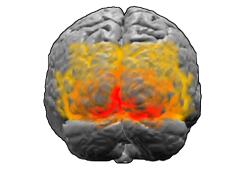
Posterior cortical atrophy (PCA) is a progressive neurodegenerative syndrome that initially affects the visual perception system located in the back of the brain. Most cases are found to stem from Alzheimer’s pathology and therefore PCA has been traditionally classified as a rare visual variant of that disease. Over time, the atrophy can spread into other regions of the brain resulting in typical dementia symptoms (e.g., memory issues).
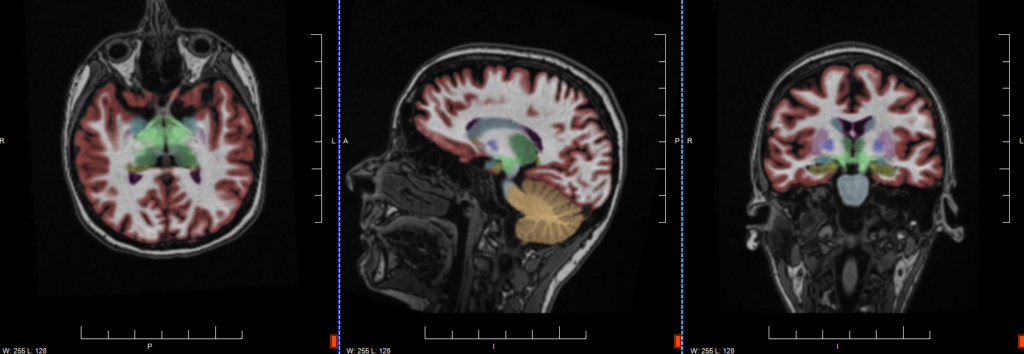
Alzheimer’s with dementia normally develops after the age of 65 but PCA can have a much younger onset age. Although most people living with PCA are diagnosed with the syndrome between the ages of 50 and 60, others may begin suffering symptoms in their forties.

I see the teacup with my eyes, but my brain refuses to send me the teacup message. It's very Zen. First, there is no teacup and then, because I know there is a teacup, the teacup will appear the next time I look.
Sir Terry Pratchet
Author
who was “thoroughly annoyed that he had [PCA] dementia”
Common Symptoms
The symptoms of PCA can vary across patients and change as the condition progresses.
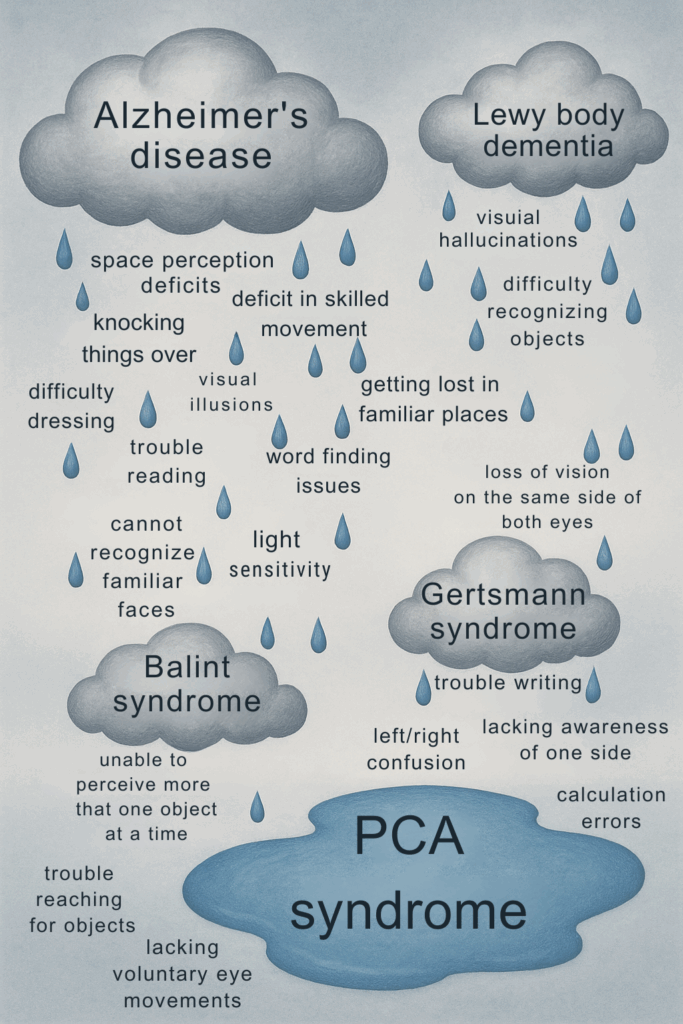
The ability to interact with and make sense of the visual world is often severely affected in PCA.
I Can See But I Can't See
Objects may appear to move, popping in and out of the visual field. It is not unusual for someone living with PCA to be able to see something as small as a pill on the ground but be unable to see things right in front of their faces.
Seeing the Trees But Not the Forest
One symptom of PCA is being able to recognize individual elements of a complex visual scene but they are unable to grasp the overall meaning.
Language
Although language abilities are relatively spared, some individuals diagnosed with PCA have difficulty with word finding and language comprehension. Therefore, they may exhibit tangential conversational styles that lack focus.
Living with PCA
A Few Words from Our PCA Experts
“Please do not infantilize me. I am still capable of so much. This may not be true for all patients, but I will ask if I need help. Let me try on my own first. Please don’t take away the things I can do earlier than the disease steals those things from me!”
Watch the video to hear more from our PCA experts.

Research
Crutch, S. J., Schott, J. M., Rabinovici, G. D., Murray, M., Snowden, J. S., van der Flier, W. M., et al. (2017). Consensus classification of posterior cortical atrophy. Alzheimer’s & Dementia, 13, 870-884. Article
Firth, N. C., Primativo, S. Marinescu, R. V., Shakespeare, T. J. Suarez-Gonzalez, A. Lehmann, M., et al. (2019). Longitudinal neuroanatomical and cognitive progression of posterior cortical atrophy, Brain, 142(7), 2082–2095. Article
Holden, S. K., Bettcher, B. M., & Pelak, V. S. (2020). Update on posterior cortical atrophy. Current Opinion in Neurology, 33(1), 68-73. Article
Wong, B., Lucente, D. E., MacLean, J., Padmanabhan, J., Quimby, M., Brandt, K. D., et al. (2019). Diagnostic evaluation and monitoring of patients with posterior cortical atrophy. Neurodegenerative Disease Management, 9(4), 217–239. Article
Tips for Living with PCA from Dr. Pelek at Anshutz
Information from MHG Clinics: Harvard
Rare Dementia: Resources
It Is Time To Talk About
Posterior Cortical Atrophy

PCA changes the way you see the world but it does not have to take away your voice or your value. If you or a loved one are living with the syndrome, contact us to add your PCA experiences to our efforts to raise awareness of the syndrome. Medical experts can get involved as well.

In our educational talks, we share some of the information we gain from interviews with medical professionals. Although they are knowledgeable, the most valuable insights often come from those living with PCA. Contact us to arrange to hear from these PCA experts.
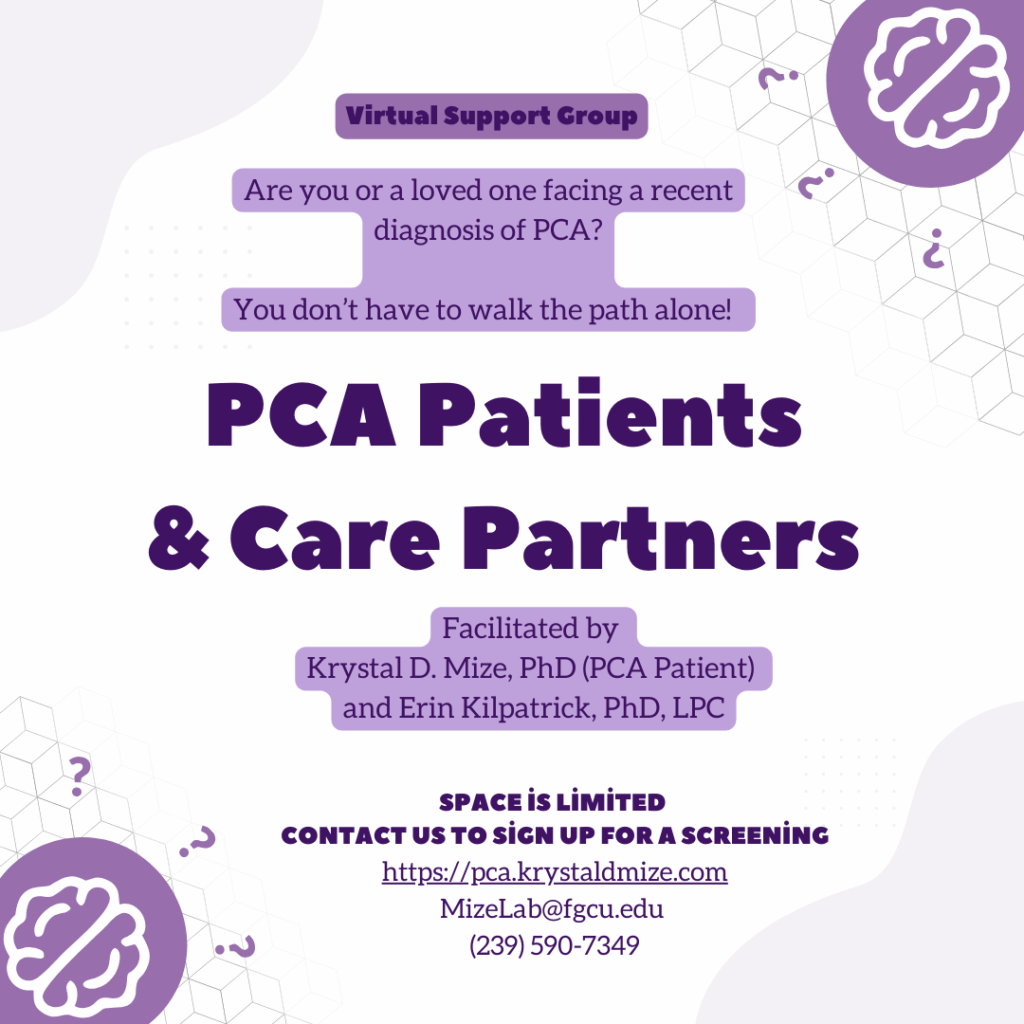
Feeling lost after receiving my diagnosis, I joined a support group. I felt less alone and it gave me a place to learn about living with PCA. Now I want to offer the same to others living through the early stages of PCA. Reach out to see if we have any openings in the group!
Others Can Help
Adults over 40 who are healthy or diagnosed with typical variants of Alzheimer’s disease or other neurodegenerative conditions can help us learn about differential susceptibility and brain health by completing a short 5-minute survey. Express your interest in participating in this related line of research by filling out our research interest form.
About Me
Educator • Researcher • Author • Guide Dog Handler
I am currently an Assistant Professor at Florida Gulf Coast University. Using evolutionary psychological theory as an overarching theme, I focus on behavioral and psychophysiological measures to study development across the lifespan. My primary interests are social relationships and emotions although I often explore other topics, including PCA.
As a PCA Patient...
I am learning to live again with the assistance of a good medical team, family support, and my guide dog.
Achievements
PhD
Experimental Psychology
MA
Psychology
BA
Experimental Psychology